Landaco + Logo Black make it grow

Precision Agriculture · Fertiliser Management

Every Dollar Counts:

Smarter Spreading
When Urea Prices Bite

Every grower knows the feeling when fertiliser invoices land. Cut back and cop the risk, or hold rates and wear the cost. New GRDC research suggests there is a third way, and the machine doing the spreading matters more than most people think.

Ask any grain grower right now and you will hear the same thing: input costs are one of the biggest headaches going into the 2026 season. Urea and phosphorus (and fuel) remain among the largest variable costs on the farm, and with prices spiking as high as $1,500 a tonne, the pressure to find savings wherever possible is real.The temptation is simple: spread less and manage the risk. But that instinct can quietly cost more than it saves. Two papers presented at the GRDC Narrabri Grains Research Update in March 2026 land at the same conclusion: cutting rates without data behind you is not a cost-saving strategy. It is a yield risk.

“Soil testing and precision or variable nutrient application become more valuable as nutrition costs rise.”

Source: GRDC Research, 2022 (consistently reinforced through 2026 updates)

This is not an argument for spending more. It is an argument for spending better, and understanding exactly where on your paddock every dollar of fertiliser is actually earning its keep.

Switching Farming Systems Won't Fix a Pricing Problem

When urea gets expensive, it is natural to wonder whether a different farming system might just need less of it. Researchers from Queensland DPI and CSIRO spent ten years looking for that answer across sites in Narrabri, Spring Ridge, Billa Billa and Pampas.

The short answer: not really. Systems with more legumes or lower cropping intensity did use less nitrogen, but the savings were modest and the profitability rankings between systems barely shifted, even when urea was priced at $1,300 a tonne. The research is clear that urea pricing alone should not be driving your farming systems decisions.

What it should be driving is how precisely you apply the nitrogen you do use.

For the full findings, see: The Importance of Urea Pricing in Farming Systems Performance, GRDC Narrabri Update.

Cutting Rates Is a Multi-Season Gamble

Here is the thing about nitrogen that makes it genuinely tricky: the consequences of under-applying do not always show up this season. The GRDC RiskWi$e trials in northern NSW tracked different nitrogen strategies across three consecutive seasons at Gurley, and the results told a familiar story.

In a couple of lean years, the differences between strategies were not dramatic. Then a good season arrived, and everything that had been quietly building in the soil, or quietly depleting from it, came due all at once. The treatments that had maintained a healthy nitrogen balance through the tough years were the ones that capitalised when it counted. The ones that had cut back were left short when the opportunity was right there.

Across 33 RiskWi$e field experiments nationally, the finding is consistent: profitability over multiple seasons is maximised when you are replacing roughly what you are removing, not banking on making it up later.

Cutting rates to save on today’s urea bill is a decision whose real cost might not show up until 2027 or 2028. That is the gamble.

For the full findings, see: Improving nitrogen fertiliser decision making in northern NSW, GRDC Update.

Your Paddock Is Not Uniform. So Why Spread Like It Is?

One of the most striking findings from recent GRDC field trial work is just how dramatically nutrient requirements can vary within a single paddock. Using a method that combines soil pH mapping with satellite imagery, researchers identified zones within the same paddock where the optimal phosphorus rate to maximise gross margin ranged from zero all the way up to 50 kg P/ha.

The areas showing the greatest responsiveness tend to share a common profile: higher soil pH paired with lower early-season crop vigour. These are the zones where phosphorus is being locked up by the soil chemistry, where standard replacement strategies quietly underperform, and where a targeted higher rate genuinely pays off. Meanwhile, other zones in the same paddock may need little or nothing at all. A flat application rate across both zones is the worst of both worlds: too much product going onto ground that does not need it, and not enough going onto the ground that does.

For the full findings, see: Using NDVI and pH maps to guide P fertiliser inputs at the paddock scale, GRDC Update
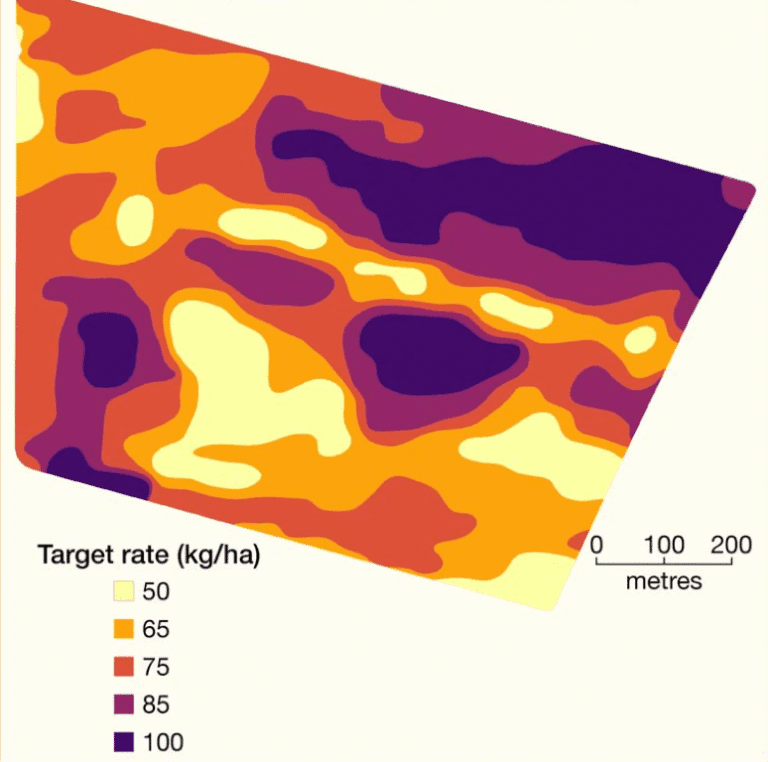
Urea Prescription Map For Top-Up Nitrogen

Where to Start

If you are not already running variable rate, the conversation to have right now is with your agronomist. A soil pH map overlaid with NDVI data from the previous season is a practical starting point that the GRDC research has validated across hundreds of paddocks. From there, a prescription map can be generated and loaded directly into an ISOBUS-compatible controller.

If your spreader is already variable rate capable but running an older spinner system, it is worth asking whether your spread accuracy is keeping up with the quality of your maps. The ICS upgrade is available as a complete kit or bolt-on solution for all Landaco spreaders, meaning many machines up to 10 to 20 years old can be brought to current AFSA-accredited standard without replacing the whole unit. Use our online calculators and resources as a starting point, or browse the full spreader range to understand your options.

The data tools are better than they have ever been. The prescription technology is proven. When fertiliser costs are elevated, the only question is whether the machine doing the spreading is accurate enough to make that investment count.
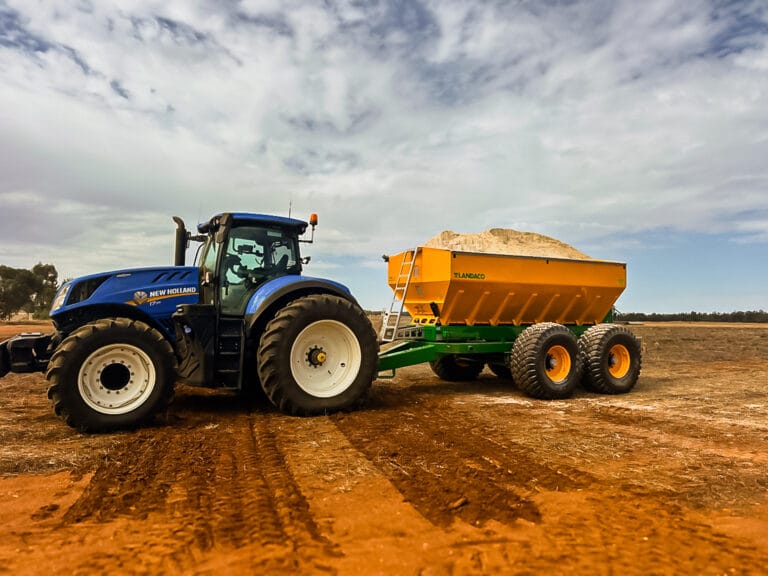
Landaco T160S Spreader. Loaded for Variable Rate Lime Application

The Landaco Precision Spreading System

Two technologies working together: the Topcon ISOBUS Athene controller for variable rate integration with your tractor’s mapping system, and the 4B8 ICS Spinner System for AFSA-accredited, consistent spread pattern delivery across all products and rates. Available on new Maxispread and Agrispread models, and as a complete kit or bolt-on upgrade to existing Landaco machines.

Two Things Have to Work Together

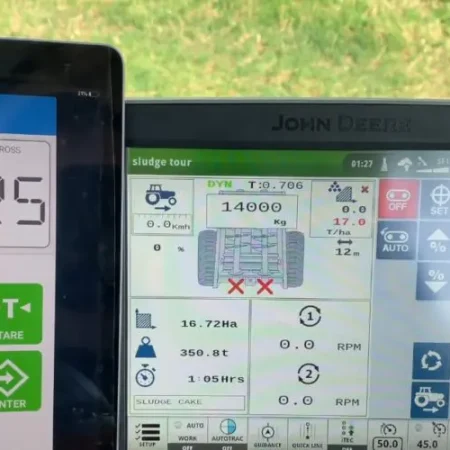
Variable rate spreading is the practical answer to all of this. But it is not one piece of technology, it is two, and both need to be doing their job properly for the system to deliver real value.The first is the rate controller. Landaco’s variable rate setup uses the Topcon ISOBUS Athene controller, which integrates directly with your tractor’s GPS and mapping system. As you move across the paddock it reads the prescription map in real time and adjusts belt speed accordingly. More product where the crop needs it, less where it does not, without the operator having to touch a thing.The second is spread accuracy. A variable rate controller can tell the machine to apply 50 kg/ha in one zone and 150 in the next. But if the spinner system is not putting product down evenly at those rates, the prescription is just a number on a screen. You can still end up with striping, patchy coverage and wasted product, no matter how good your maps are.
Getting the rate right is one thing. Getting the product where it needs to go, evenly and reliably across the full working width, is another matter entirely.
This is the problem the 4B8 ICS Spinner System is built to solve. Tested and approved by the Australian Fertiliser Services Association across more than 20 spreaders, it is accredited for a 36-metre spread pattern at application rates from 50 to 400 kilograms per hectare. For urea, the system delivers a spread range of 36 to 39 metres.

That performance matters more right now than it ever has. When urea is sitting at today’s prices, an uneven spread pattern is not just an inefficiency, it is money on the ground in the wrong place. The thing is, plenty of spreaders on the market have never been independently tested. New paint and a new price tag does not mean the product is landing where it should. Without AFSA accreditation, there is no independent proof of what the spread pattern actually looks like at different rates across the full working width. If your spreader cannot back its accuracy with independent testing like a Landaco can, your prescription map is doing half a job.

Sources & Further Reading

Get Started with Variable Rate Spreading

Ready to transform your spreader with precision technology?
Fill out the form below and our team will be in touch with personalised recommendations for your operation.
Prefer to chat first? Contact our sales team

Learn More About Precision Agriculture

Explore our latest insights on variable rate spreading and precision farming technology.

error: